
When a fire alarm sounds, everyone in your building needs to know — including employees or customers who can’t hear a standard audible alert. Fire alarm notification devices are the bridge between a functioning system and a fully compliant, life-safe building.
Yet many Northeast Ohio business owners don’t realize their current setup may fall short of ADA and NFPA requirements until a fire marshal inspection or an insurance review catches the gap. By then, you’re already behind.
This article breaks down the types of notification devices available, what compliance actually requires, and how to know whether your system is doing its job.
ADA Requirements for Fire Alarm Notification Devices
ADA-compliant fire alarm notification systems in commercial buildings must include both audible and visible alerting devices. [1] Key requirements include:
- Audible alarms must produce a minimum sound level of 15 dB above ambient noise, or 5 dB above the maximum sound level, whichever is greater
- Visual alarms (strobes) must be installed in all common-use areas, restrooms, and any space where audible alarms may not be heard
- Strobe placement must follow spacing and candela output standards outlined in NFPA 72
- Coverage must extend to corridors, lobbies, meeting rooms, and break rooms
Standards are governed jointly by the ADA Standards for Accessible Design and NFPA 72
Types of Fire Alarm Notification Devices
Most commercial fire alarm systems rely on two categories of notification devices — audible and visible. In the majority of compliant commercial buildings, you need both.
Audible Notification Devices
Audible devices are what most people picture when they think of a fire alarm. But there’s more variety here than a single horn on the wall.
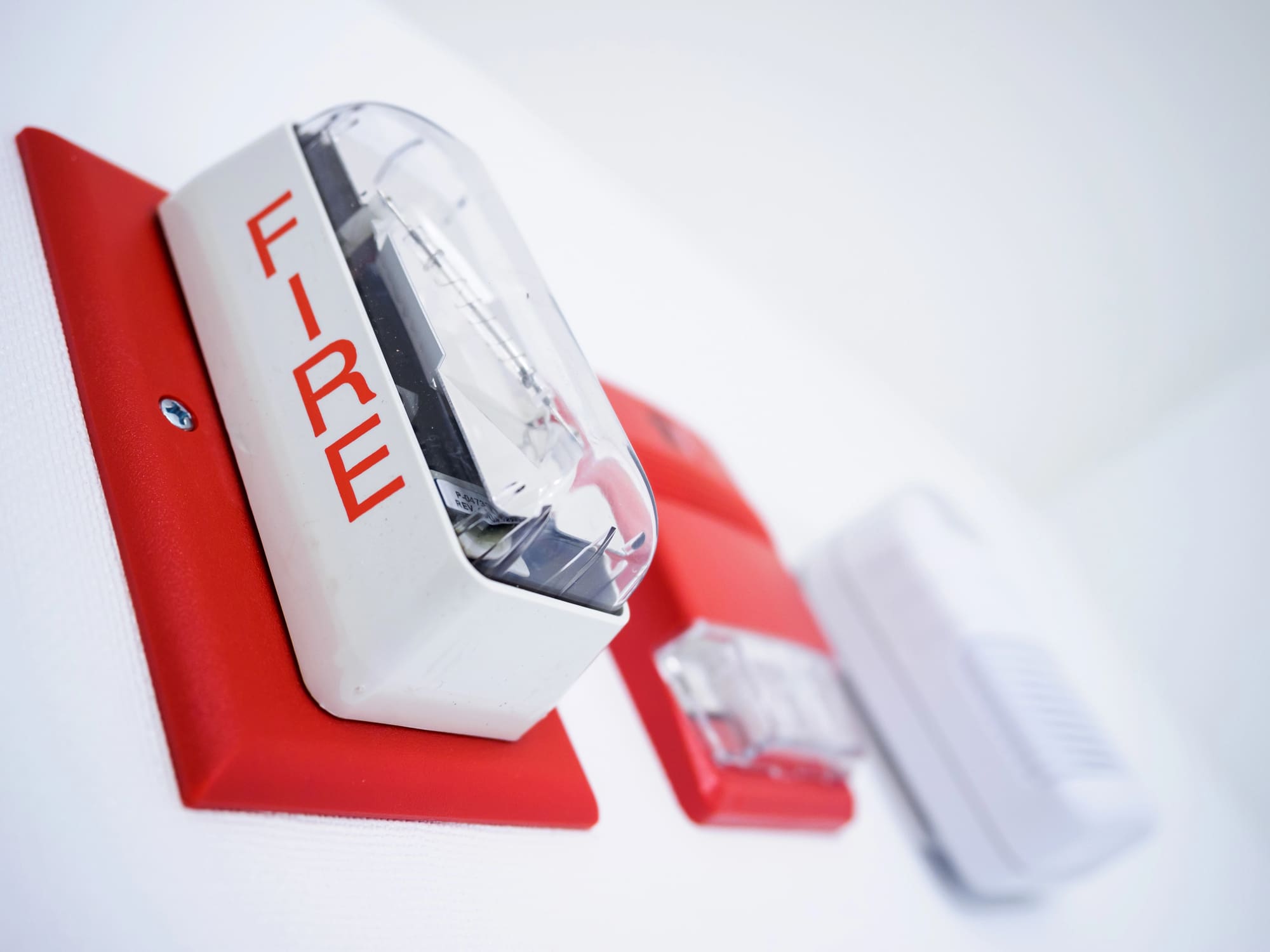
- Horn/strobe combos — the most common configuration in commercial settings; they handle both audible and visual alerting in one unit [2]
- Speakers — used in voice evacuation systems, which deliver recorded or live verbal instructions during an emergency
- All audible devices must meet minimum decibel output requirements relative to the ambient noise level in the space
- High-ambient-noise environments — think manufacturing floors, commercial kitchens, and warehouses — may require additional coverage zones to hit those minimums
Quick compliance note: An audible alarm alone is never enough. Any space where someone might not hear the horn requires a visual device too.
Visual Notification Devices
Strobe lights are the visual counterpart to audible alarms, and they’re required in all areas where audible devices alone won’t cut it. [3]
- Candela output requirements vary by room size — a strobe that’s perfectly adequate in a small office may be completely inadequate in a large open warehouse
- Wall-mount vs. ceiling-mount placement rules differ — high ceilings trigger different spacing standards, and getting this wrong is one of the most commonly cited deficiencies during fire marshal inspections
This is the category where buildings fail most often, and it’s almost always a detail that gets overlooked during renovation or expansion.
Where Notification Devices Are Required in Commercial Buildings
A lot of business owners assume that a few horns and strobes scattered through the main work areas is enough. It’s not — and that assumption is exactly what leads to failed inspections.
The requirement isn’t just about covering the spaces where people work. It’s about covering every space where any occupant might be at any given time. Think of it as a “no dead zones” rule — if someone can be there, the alarm needs to reach them.
Here’s where notification devices are required:
- Common areas — lobbies, hallways, and corridors
- Restrooms — both audible and visible devices are required here, full stop
- Break rooms and meeting rooms — these get overlooked constantly during renovations
- Sleeping areas — required in hotels, assisted living facilities, and any building with overnight occupancy
- High ambient noise areas — spaces where standard audible output may not be sufficient require special consideration for additional coverage
- Outdoor areas — anywhere employees may be working outside the building perimeter
If your building has been renovated or expanded since your system was originally installed, there’s a good chance some of these spaces were never added to your notification coverage map. That’s one of the most common gaps we see in Northeast Ohio commercial properties.
Not sure if your current system covers every required area? Rhodes Security Systems offers professional assessments for Northeast Ohio businesses. Call (440) 946-6685 to schedule your fire alarm system assessment.
NFPA 72 vs. ADA — Understanding the Overlap
If you’ve ever sat across from a fire marshal and heard both “ADA” and “NFPA 72” referenced in the same conversation, you’re not alone in feeling confused about which one actually governs what. They’re related, but they’re not the same thing — and both have to be satisfied.
Here’s a plain-language breakdown:
| ADA Requirements | NFPA 72 Requirements | |
|---|---|---|
| Governed by | ADA Standards for Accessible Design | National Fire Alarm and Signaling Code |
| Primary focus | Protecting individuals with hearing or vision impairments | Technical installation standards for fire alarm systems |
| Who enforces it | U.S. Department of Justice | Local fire marshals and building officials |
| Applies to | Accessibility of notification for all occupants | Device placement, output specs, and system performance |
The part that trips people up: a system can be fully NFPA 72-compliant and still fail ADA requirements. They cover different ground, and both sets of standards have to be met simultaneously.
There’s one more layer worth knowing about — Ohio. Local amendments to NFPA 72 can add requirements that go beyond the base national standard. What’s compliant in another state isn’t automatically compliant here. That’s where working with a local expert makes a real difference. Rhodes Security Systems stays current on both state and local code requirements, so you don’t have to track every update yourself.

Common Compliance Gaps That Fail Inspections
This is the section worth reading twice. Fire marshal inspections don’t just look at whether you have a system — they look at whether your system actually does what it’s supposed to do, everywhere it’s supposed to do it.
Here’s what inspectors actually look for, and where commercial buildings most commonly fall short:
- Wrong candela rating for the room size — strobes are installed, but the output isn’t strong enough for the space they’re covering
- Missing devices in restrooms or break rooms — these spaces get skipped more often than you’d think, especially in older buildings
- Audible devices not meeting dB minimums in high-noise environments — a horn that works fine in an office won’t cut it on a manufacturing floor
- Outdated horn/strobe combos — older units that predate current NFPA 72 edition requirements may no longer meet the standard, even if they were compliant when installed
- Visual devices at incorrect mounting heights — placement that doesn’t meet current spacing standards is a fast path to a citation
- Gaps in renovated or expanded spaces — additions to a building often get overlooked entirely; the new square footage never makes it onto the notification coverage map
- Systems that haven’t kept pace with code updates — a system that was compliant under an older code edition isn’t automatically compliant today
That last one catches a lot of business owners off guard. Compliance isn’t a one-time checkbox. Codes update, buildings change, and workforces change — and your system has to keep up with all of it.
When to Upgrade Your Notification Devices
Not every building needs an immediate overhaul — but there are some pretty clear signals that it’s time to take a hard look at your current setup. If any of these sound familiar, a professional assessment should be your next move.
- Your system is 15 or more years old — technology and code requirements have both moved on
- Your building has been renovated or expanded since the last inspection — new square footage almost always creates new coverage gaps
- You’ve had a recent failed inspection or citation from the fire marshal
- Your insurance carrier has flagged notification coverage as deficient — this one tends to come with a deadline attached
- Employees with hearing impairments have joined your workforce — your legal obligations under the ADA shift when your occupancy profile changes
- You’re moving into a new or previously occupied commercial space — never assume the previous tenant left a compliant system behind
- Your monitoring company has flagged device performance issues during routine testing
Any one of these situations can create real exposure — legally, financially, and from a life-safety standpoint. A business of any size can have compliance gaps. The fastest way to know exactly where you stand is a professional assessment, not a best guess.
Don’t Wait for a Failed Inspection to Find Out Where You Stand
If your building hasn’t had a fire alarm notification assessment recently, there’s a good chance something has changed — your occupancy, your layout, your workforce, or the code itself. Rhodes Security Systems has been helping Northeast Ohio businesses stay compliant and protected since 1974. Schedule a professional assessment today and know exactly where your system stands before your next inspection finds out for you.
Call (440) 946-6685 to schedule your professional assessment.

Fire Alarm Notification Devices: Your ADA and NFPA Compliance Questions Answered
What are the ADA requirements for fire alarm notification devices in commercial buildings?
ADA-compliant fire alarm notification requires both audible and visible alerting devices in commercial buildings. Audible alarms must produce a minimum sound level of 15 dB above ambient noise, and visual strobes must be installed in all common-use areas, restrooms, and any space where audible alarms may not be heard. Both the ADA Standards for Accessible Design and NFPA 72 govern these requirements.
What are the two main categories of notification devices used in commercial fire alarm systems?
The two main categories of fire alarm notification devices are audible and visible. Audible devices include horns, horn/strobe combos, and speakers used in voice evacuation systems. Visual devices are strobe lights, required anywhere an audible alarm alone won’t reach every occupant. In most compliant commercial buildings, both types are required — one without the other typically isn’t enough.
How does NFPA 72 address fire alarm notification standards?
NFPA 72 sets the technical installation standards for fire alarm notification devices — covering device placement, candela output for strobes, spacing rules, and system performance requirements. We always reference it alongside ADA requirements because a system can be fully NFPA 72-compliant and still fall short of ADA standards. Both must be satisfied at the same time.
Resources
- https://adata.org/factsheet/fire-alarms
- https://www.sdmmag.com/articles/85224-horns-strobes-clarifying-code-requirements
- https://www.ecmag.com/magazine/articles/article-detail/strobe-light-requirements-proper-location-of-visible-notification-appliances